Showing posts with label horology. Show all posts

Wednesday, September 09, 2009

Odd pocket watch


Stopped by the thrift store and found a pocket watch. Was not running, but the stem felt like a handwind, and I have never seen a quartz marked "antimagnetic". Center seconds means it is more than likely a wristwatch movement in a pocket watch case, and probably a cheap one at that. Not something I particularly want in my collection, but more than likely I can get it running with a few drops of oil and make a small profit on Ebay.


When I opened it up, I found that it was indeed the cheap pinlever wristwatch movement I expected, but I also found a little circuit board, batteries, and a piezo speaker on the case back, a strange combination.

It turns out that with fresh batteries, it plays Greensleeves when opened.

There can only be a few years in the late 70's or very early 80's where this made any sense--any earlier and the electronics would be either unavailable or expensive, and much later and all the cheap wind up movements were replaced by quartz.

Friday, March 27, 2009

Plastic Crystal Polishing


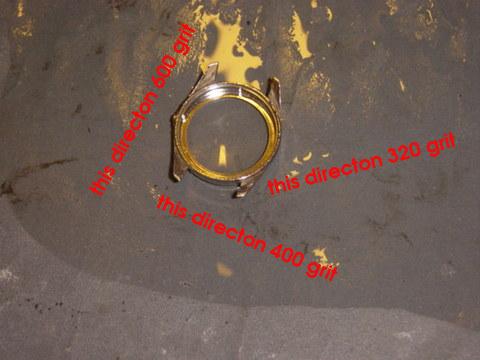
Plastic crystals scratch easily. Luckily, they also polish easily--if you have the supplies handy, it takes about 5 minutes to restore most scratched plastic crystals to nearly new condition. This is a crystal that I deliberatly scuffed up to illustrate.


With a few minues work, you can turn it into this. Yes, this is the same crystal, and taken after the first picture.


You will need wet sandpaper in 600 grit, plus 400 and 320 or so for severely scuffed watches. Metal polish of some sort, (I use Wrights silver polish or Brasso) and an applicator of some sort. I use an old fuzzy mouse pad, both to cushion the sandpaper and to apply the metal polish. I've also used the back of a chunk of vinyl cloth--you want something just slightly absorbent, not too coarse, but stiff enough so it doesn't bunch up when you polish with it.


Put the sandpaper on the table, ideally on a slightly padded surface. Sand by moving the watch across the sandpaper. First sand across the direction of the worst scratches. with the coarsest sandpaper you will use. For most crystals, you will need to tip the watch case to get to the outside of the crystal. Pay close attention that you don't sand the case itself. A few drops of water will make the sandpaper last longer without getting clogged with plastic, but don't go overboard, especially if the watch isn't water resistant. Periodically stop and dry the crystal off to inspect. When you almost have the worst scratches sanded out, or sanded as much as you think appropriate (if you have one extremely deep scratch you may consider leaving it partially visible rather than thinning the entire crystal that much), switch to the next finer grade, and sand in a different direction. Once the scratches from the original sandpaper are sanded out, switch to the next finer grade and again sand across the direction of the previous sandpaper. Repeat until you get to the finest paper you will use--I recommend at least 600 grit. 400 will work as the final, but often leaves wavy areas.

You will wind up with an evenly frosted crystal.


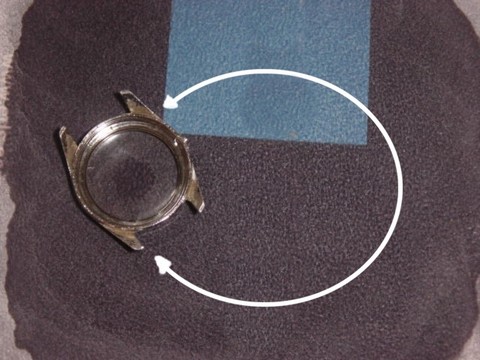
The final step is polish. Put a little polish on your polishing pad if it hasn't been used before, and possibly a drop or two of water. Run the watch in circles across the polish, again rocking to get the edges, and periodically drying and checking the condition. Avoid polishing the case, especially if goldtone.

You will probably wind up with a nice looking crystal, and a bunch of polish stuck in the cracks. A damp toothbrush works well to remove the excess polish. It works better if the bristles are cut to about half length.

I save the pad, and I don't need to put more polish on it most times.

Wednesday, March 25, 2009

Automatic Winding

The first effective automatic wind system was the one used in the Rolex Oyster Perpetual. The Oyster Perpetual was revolutionary--One of the first, if not the first practical water resistant case, combined with the first practical automatic winding system. The original intent of the automatic wind wasn't primarily convenience but rather to maintain water-tightness--By eliminating the need for daily winding the screw-down crown would last longer, and there would be less chance of forgetting to tighten it. This also has the advantage of keeping the watch at a constant state of wind, reducing the potential for isochronal error. (Sorry, I don't own a Rolex to take pictures of, but there is an interesting and not very complimentary illustrated review here)

The Rolex patent covered a 360 degree rotating rotor. Watch companies that wanted automatic winding had to bypass this patent, and so they came up with the bumper wind automatic. The rotor (at the bottom of the movement, marked "seventeen jewels ERNEST BOREL) was set to be free to move in the most common positions, with a simple ratchet turning the center gear which runs through reduction gears to wind the mainspring. Bumpers (shown here in the upper left) restrained it from making a full revolution. Not tremendously different in basic concept, but less efficient than a rotor that can rotate 360 degrees. It does have the advantage of being a bit flatter than a 360 degree rotor. (Click pictures to enlarge) This particular movement was made between 1935 and 1945. Bumper winds continued for some time after the Rolex patents expired, with some models still produced in the 1950's.


Like the bumper wind automatic, the Rolex only wound the watch when the rotor was turning in one direction. In the opposite direction, the system allows the rotor to spin freely. In 1942, the Bidynator was introduced, the first automatic that wound the watch with either direction of the rotor. The bidirectional design means it can stay wound with less arm movement. Note that this watch clearly uses a jewel for the rotor bearing, but remains marked "17 jewels". This means at least one of the standard jewels in the timekeeping section is missing.


Both the Rolex and the Bidynator used a simple post arrangement for the rotor. Rolex still uses a somewhat fragile jeweled post, one of the weaknesses of their design. Eterna was responsible for the next major innovation, a ball bearing rotor in 1948, on the Eternamatic. The Eterna version used 5 ball bearings, and Eterna took this as their trademark. This was another increase in efficiency and durability, and eventually became the standard on most automatics. Shown is an AS 1996, made long after the Eterna patents expired.


In the early 50's, Timex designed a low-cost automatic based on their existing pinlever movement. It used an eccentric cam on the rotor that moved a lever arm back and forth. (Right hand picture is of the same movement, with the rotor removed) The lever had fingers on the other end that engaged a ratchet on each direction, turning an axle which turns a planetary reduction gear, in turn winding the mainspring. Note that this particular movement is the jeweled version, with the unusal D-shaped jewel pins visible in the hole about 1/3 from the top, and 2/3 to the right.


In the late 50's, Seiko introduced their magic lever automatic system--Similar in concept to the Timex system, but greatly simplified. The 4 piece finger system is reduced to a single flexible arm. The diameter of the ratchet wheel is increased, with a simple pinion rather than the planetary reduction of the Timex. The original versions used an eccentric cam on the rotor similar to the Timex. On the 7000 series movements (a 1970 7005 shown), the eccentric is moved off the rotor to a separate gear. Although this appears to increase complexity, it allowed Seiko to eliminate a separate bridge for the automatic wind system, making the movement thinner without affecting durability. Another simplification on most Seiko automatics is the lack of a hand-wind capability, with these parts often modified to adjust the calendar instead.

A teardown of a 7005 movement, with better pictures describing the magic fingers is here.

A teardown of a Swatch automatic, using the same system as most modern Swiss automatics is here.

Friday, March 20, 2009

Watch Photography

The key to good photography is lighting. Most often you want diffused, even light rather than point sources. My wife bought a "portable studio" that included a light tent, a background cloth, a tabletop tripod and 2 small daylight filtered halogen lights. This was an improvement, but it was also a pain to set up--In our house it is hard to find a big flat area other than the floor that isn't already occupied. I'm too old to lie on the floor. I made my own version of the studio suited for my work area. My watch workbench has track lighting, giving me 6 movable halogen spotlights. This wasn't meant for photography--it was a cheap way of getting lots of light to the small area where I fix watches. By themselves, the lights are lousy for watch photography--lots of reflections, hard to see detail. However, they did make a good base for lighting a light tent. I took a square wire grid from shelving, draped sheer white fabric over it, and attached a magnet. The magnet sticks the grid to a shelf bracket mounted in my work area, and the sheer fabric diffuses the lights. Sometimes the windows will add undesired reflections. When that happens I clothes pin a dark cloth with a hole for the lens. The hole is cut off center, so I can get various heights depending on how I clip it. The camera's white balance is set for incandescent--otherwise chrome cases are likely to look gold. The kit my wife got included a background cloth, I use it. This setup isn't perfect, but I'm looking for decent results with little effort--it succeeds at that. It is far easier to get good pictures with this setup than with others I have tried, and it sets up and stores quickly. The next addition is probably going to be an adjustable light that I can set up in different positions For a point and shoot without good native macro ability, I velcro a jeweler's loupe to the front of the lens. Focus is essentially done by moving the camera--you have to use the LCD screen. I'm using jeweler's loupes, available from Harbor Freight. a 2 or 3x is about right for a wristwatch, the 10x for individual parts. . In this case, I cut the front half of the loupe off, to avoid shadows on the pictures. My current Kodak has a bigger, better lens than most point and shoot cameras, but that gives its own problems--The lens is too big to attach a loupe, and when holding one in place, the depth of field is about 1mm--If I'm focused on the top of a part, the bottom is out of focus. You can see here that one arm of the balance is almost in focus, the spring below blurry, as is the pivot above. This can be controlled by manually selecting a higher F-stop number, giving a greater depth of field. Cameras with smaller lenses typically have a wider depth of field, so this isn't as much of a problem. A tripod makes all of this much easier, and is essential when the shutter speed gets low, as often happens when I change the f-stop. You don't need a fancy tripod, a tabletop model will work OK, although a floor model gives more flexibility. My floor tripod has a rack to carefully adjust the height, which makes focusing by distance easier. A quick and dirty alternative to the light tent is a flash diffuser. I used to use watch paper held in front of the flash. (watch paper is similar to wrapping tissue) Anything sufficiently translucent will help, even just plain white paper. This eliminates white balance problems, cuts the flash power down so it doesn't overexpose, and softens up the shadows compared to raw flash. The tripod is less necessary to prevent blur from camera shake, but may be useful to assist in holding the position for proper focus.

Thursday, March 19, 2009

PInlever or jeweled lever

The escapement is the part of a mechanical timepiece that sets the rate. It is the most crucial part to accuracy. The escapement on a watch is made up of the balance, hairspring, fork and escape wheel. (Click the picture to enlarge enough to read the labels. Picture is a 17 jewel Chinese skeleton watch. The part marked "fork" is the lever) The balance wheel and hairspring combine run at a particular rate, generally between 3 to 8 ticks per second. This is based on the elasticity of the hairspring and the mass and weight distribution of the balance. Adding weight or increasing the effective diameter of the balance will slow the rate down. Increasing the length or decreasing the springiness of the hairspring will also slow the rate down. Older watches were "tuned" roughly by adding or removing tiny screws and washers to change the weight of the rim. Ideally these would be added in pairs, so as not to change the poise (see below). Watchmakers would have packages of washers, each adding a certain number of seconds. Fine adjustment would be made with the regulator, a movable slot that slides along the hairspring, changing the effective length. The mainspring attempts to turn the gears in the watch. The gears transmit this power to the escape wheel. When it rotates, it pushes on one arm of the lever, which in turn "kicks" the balance and causes it to rotate. The other arm of the lever blocks the escape wheel from turning more than 1/2 tooth. When the balance turns, it winds the hairspring until the hairspring is tight enough to make the balance go the opposite direction. The balance will then begin to move the lever--When the lever is released the arm blocking movement of the escape wheel releases it, gets another kick, and the first arm moves to block the escape wheel. This process repeats 3-8 times per second, depending on the watch. Consistency is the key to a well-running watch. Temperature, position, how far the watch is wound, magnetism and friction all have an affect on the rate. Much of the cost of a fine movement is in counteracting these errors. If the balance wheel is not perfectly poised (balanced), it will change how it rotates depending on the orientation of the watch-it may run differently when stem up than when stem down. This is known as positional error. On screwed balances this is adjusted by moving individual washers or screws from one screw position to another--This would keep the overall mass (and therefore the overall rate) the same, but change the poise. On smooth balances this is done by removing material from the proper spot on the balance rim. Traditional steel hairsprings change their elasticity or "springiness" at different temperatures. Old high-grade watches would counter this by having split bimetalic balances with screws. The rim of the balance was made of a sandwich of different metals, with different expansion properties, similar to a metal thermometer. Each half of the rim is attached at one end only, the other is free to move based on the temperature. Adding weight to the free end will increase the amount of temperature compensation. Adding weight to the rim near the spokes has little to no effect on temperature compensation. By moving pairs of washers to matching positions on their respective halves of the balance, temperature compensation could be adjusted without affecting poise or average rate. In the 20's, a new class of spring materials were invented that have little temperature sensitivity at normal temperatures. This allowed a smooth solid balance to equal the temperature performance of a bimetalic balance. While the rest of the movement can cause timekeeping errors, the escapement is key. Rough parts will not be as consistent as smooth, and will wear faster. Jewels in a mechanical watch are used to reduce wear and friction in critical areas. In modern watches these are synthetic sapphire or ruby. In watches before about 1902, these were actual mined gemstones--Sapphire or ruby for good watches, garnet for less expensive ones, and occasionally diamond for super grade watches. The typical jeweled wristwatch uses an anchor escapement, named after the shape of the lever. It will be at the same level as the escape wheel, and uses angled jewels glued in place where it contacts the escape wheel teeth. This gives the most consistent operation, and the best resistance to wear, but requires extreme precision in both manufacture and assembly. Jeweled lever watches would typically come in either 7 jewel models, or odd numbers between 15 and 23. 7 is enough to properly jewel the entire escapement. 17 adds jewels to all the train pivots. Jewels above 17 are of marginal value, and jewels above 23 are essentially useless. (This is only counting the jewels in the basic timekeeping section, not in additions like automatic wind modules) Watches with a single jewel are not considered jeweled. The picture to the left is of 3 watch levers--The one above the date is a jeweled lever, the clear red blocks are jewels. A pinlever is more forgiving. giving up precision in operation and long-term durability for ease of manufacture and in some cases impact resistance. The pinlever is simpler, usually stamped sheetmetal rather than the more complicated assembly of a jeweled lever. It sits below the level of the escape wheel, with round pins extending up to engage the escape wheel teeth. The shape of the pins requires a different shape of escape wheel teeth, and the interaction of these parts is compromised. Friction is higher, and is generally compensated by using a stronger mainspring, which also adds wear. These may use a layout similar to the anchor, or have a different angle between the pins and the tail. Both levers behind Lincoln's head are pinlevers. Pinlever watches are most often either unjeweled (the traditional mechanical Timex) or have a single jewel (most Swiss and Hong Kong pinlevers). There were some pinlever watches with jeweled pivots--many of these would get extra useless jewels so they could claim "17 jewels" or more. These were a bit better than their unjeweled cousins, but not as good as a seven jewel with a fully jeweled escapement. Timex had a wierd hybrid--a 21 jewel version of their basic unjeweled pinlever, with shaped, jeweled pins.

Saturday, March 14, 2009

Promotional watch

This is most likely from the 60's or early 70's. It has an aluminum case, although at least this one has a stainless steel back. Inside is a cheap pinlever movement. The dial is printed paper. More than likely this watch was given away as a prize rather than sold.

Aluminum cases were not successful in their original versions--The aluminum was soft, and the protective coating would scratch easily. This would let the aluminum pit badly, even worse than plated brass.

This particular watch is an interesting variation on the "mystery dial" watch. Mystery dial watches use disks with pointers instead of hands, giving the illusion that the pointers are floating. The most common type has conventional hour and minute hands, and uses a disk for seconds, often with an animal or vehicle "running" around the perimeter of the dial.

This watch also uses a disk, but for a different purpose--It retains the seconds hand, and the disk is polarized. There is another polarized disk covering the dial. When the disks are oriented so the polarization crosses, the dial appears black, as this .

When the polarized disks align, the logo under the bottom disk appears:


So using 60's or earlier technology, they were able to make a watch with a disappearing and reappearing face, cheap enough to be a givaway.

Friday, March 06, 2009

Good Watch

Dad has a Seiko Automatic from 1971 that Mom bought him new. He wore it daily for many years, and still wears it occasionally. He worked construction during the summers while in college, and often his watch was the only one on the crew that wasn't fogged up to unreadability. It is probably seeing him with this watch (and its nearly identical quartz replacement) that shaped my view of an elegant everyday watch--Silver-white dial, simple stick markers, stainless steel case. Around 1992, Mom and Dad bought me my own quartz version, pictured here. It was basically abused for 13 years or so--I rarely took it off even to shower or swim.

When Mom bought Dad's first Seiko, the brand was fairly new to the US market, although they had made either movements or entire watches for US brands--The top of the line Timex in the late 50's used a Seiko movement. Seiko was brought to the attention of Americans via servicemen returning from Vietnam, and wasn't imported in large numbers until the early 70's. It wasn't a horribly expensive watch, but it certainly qualifies as a good one--I'm not sure there was anything close available in the US at anywhere near the price.

Before quartz, good watches were significantly better in almost every way than cheap watches. The movements would keep better time and last longer, the cases would resist water and wear better and they wouldn't have to be serviced as often. If you wanted something accurate and durable, you had to pay.

That changed with the perfection of quartz. For all practical purposes, a dime-store watch keeps perfect time--within a few minutes per year, and will usualy withstand more abuse. The dime store watch may not last as long overall, but it will generally last as long as the maintenance interval on a mechanical, and replacement will cost less than a single servicing of a mechanical.

Besides looks, what makes a good practical watch today?

Most movements are pretty good. Swiss or Japanese are probably the best, followed by other Asian movements made by Japanese companies. As long as you keep them dry, even the Chinese quartz movements will keep time with good accuracy and last years. These are movements in watches that retail for a few dollars.

The case has become the most important difference. Ideally, the case will be all stainless, NOT "stainless back, base metal bezel. It should be water resistant, with a rated depth or ATM rating. (1ATM is equal to 10 meters) Technically you aren't supposed to shower or swim in a watch with no depth rating. Unless you are diving, an extreme rating doesn't gain much--generally seals either work or they don't.

"Base metal bezel" indicates a brass case, plated with chrome or yellow stuff. Goldtone watches are an exception--it is difficult to plate stainless, so gold-colored watches will be "base metal" to a higher price point. Gold plating or goldtone isn't as durable as chrome, and nowhere near as durable as solid metal.

Band material is personal preference. Leather bands don't last forever, but they are easy to replace. I can't wear ordinary leather bands long in the summer before they start to smell funny. Luckily I bought 45 pounds of watch bands from Ebay, and I've still got a few left... Some really nice leather bands have a "deployant" clasp--Instead of a standard buckle, there is a folding clasp like a metal band. Some people say metal bands pull the hairs on their wrists. This depends on the design of the band--Expansion bands are notorious for pulling hair. Most well-designed metal rarely if ever pull hair. Look at the sides--Cheap bands will be obviously folded metal. Better ones will still be folded, but the finish will be smoother--there will be a finishing operation after the links are folded. The best watches use solid links, and solid end pieces. The clasp on a better metal band will have some sort of extra lock--Buttons on the side, or a flip-lock.

Notice that in addition to the standard lugs, this watch has 2 extra bits attached to the case, to match the style of the band. That is known as an integrated band, and it means you pretty much can't change bands, or switch from metal to leather.

Most mid-grade watches have either flat mineral-glass crystals, or domed plastic. Mineral glass is less likely to scratch, but plastic can be buffed out with trivial effort. Better watches with flat or slightly domed crystals will have sapphire rather than mineral glass. These are very difficult to scratch.

There are some features that can be a problem. Many of the "never needs a battery" --Solar (Ecodrive) or rotor-generator (Kinetic, Auto-quartz) add needless complexity, with little benefit on a standard watch. Modern batteries can last 10 years or more, some of the energy cells in the rechargeable watches don't last much longer and are far more expensive to replace. Casio makes a line of "atomic" watches that set themselves via radio. The ones with both analog and digital display can get out of sync--save the instructions.

The less expensive Seikos and Citizens are really good values. Pulsar is a cheaper brand of the Seiko company, using the same movements. Most Pulsars are base metal, but there are some with stainless cases--These are essentially a Seiko. Casio G-Shocks are among the most durable in withstanding abuse, although their newer models don't have quite the reputation of the early ones.

Gruen, Waltham (in North America) and Elgin used to be high quality watches, but are now basic cheap base metal watches, all owned by the same company that does Sharp, Watch-it and Dickies watches. Bulova hasn't slipped quite as far, but it is nowhere near the quality it used to be, and some of their least expensive watches aren't much better than you would find at Walmart. (Bulova has recently been purchased by Citizen, who used to make watches for Bulova's budget Caravelle line)

Fossil and Diesel (same company) have neat looking features, but their cases are rarely above average--In fact, some of their cases with snap-on backs are a significant problem, fitting so tight as to be nearly impossible to replace without damaging the watch.

Saturday, February 28, 2009

I hate cap jewels

Most mechanical watches that won't run are merely dirty, and need to be cleaned and re-oiled. There is a watchmaker near me who charges around $25 to clean and oil a watch--Absurdly cheap for the work involved, but still more than I pay for most of my watches. Out of budgetary necessity, I've learned to clean and lube watches myself.

This is more involved than the phrase "clean and oil" would suggest. It requires detail stripping the watch, removing around 80% or so of the parts including the mainspring and gear train, running most of the parts through a cleaning machine with 3 different sets of solutions, drying and finally reassembly and oiling. It takes me 60-90 minutes on a simple watch I am familiar with, where nothing goes wrong.

The jewels in a watch are synthetic ruby or sapphire, used as bearings. Most are pivot jewels that remain attached to larger pieces of the movement. These have a hole for a pivot, the axle part of a watch wheel. (The gears are typically called wheels in watch repair) Where even more precision is desired, cap jewels are added. This is required on the balance, somewhat useful but extremely difficult on the fork, and marginally useful on the escape wheel. The other wheels don't benefit from extra cap jewels.

Cap jewels must be either ultrasonically cleaned, and then oiled with an automatic oiler, or they have to be disassembled for cleaning and oiling. The picture to the left shows a piece of uncooked rice next to a cap jewel. To remove this jewel, you need to carefully release the legs of the little gold spring from the notches they rest in. (Click the picture to zoom in) The spring will fold up, giving access to the cap jewel, and under that the pivot jewel. There are other types of spring that are not captive, so you have to be careful that when they are released they don't go flying somewhere.

Jewels are hard and slippery--Grab them too hard with your tweezers and they go shooting across the room. Don't grab them hard enough or straight enough and they fall out of the tweezers. This has been responsible for most of the watches that should have been repairable that I have failed to fix--the cap jewel for the balance goes missing. I've learned that the easiest way to remove them is with Rodico putty--a sticky putty that is designed to be low-residue, sold for watch repair. Replacement has to be done with tweezers. Cap jewels have a top and bottom, but it isn't apparent without magnification. Where a cap jewel is used, the pivot jewel is usually removable as well--This makes it easy to knock out of position when trying to reassemble. The pivot that rides in the jewel also gets in the way of reassembly.

Although dealing with cap jewels isn't the hardest part of watch repair, it is the hardest part of a standard clean and lube job.

Thursday, February 26, 2009

Russian Watches

The Dueber-Hampden company was one of the biggest pocket watch makers in America, but when the founder died, so did the spirit of the company. It struggled along until the late 1920's, when it was bought by the Soviet Union. The entire factory and a handful of workers were moved to Russia to jumpstart the Soviet watch industry. Apparently this factory became the "First Moscow Watch Factory", eventually taking the name Poljot. Shortly after the American workers came home, the Iron Curtain fell and contact with the Russians they were training was lost. 
 Sekonda was a brand in the United Kingdom started in the mid 60's. They initially sold re-named Poljot watches, later watches from several of the Soviet factories. In the 90's, they lost all connection to Russia and switched production to Asia. Seconda was a relatively inexpensive brand, although the examples I have are all decent fully jeweled movements. The purple faced watch here is gold plated automatic- they typically had a very thick plating, evidenced by the fact that despite the very sharp corners this watch shows no sign of brassing (Brassing is the watch geek term for worn-through plating, since most plated watches are brass) 
 Russian Calendar watches are almost all instant change--Rather than the date slowly changing over the course of an hour or two, some time within a few minutes of midnight they snap to the next day in a fraction of a second. This is done with a spring mechanism that slowly cocks itself over a few hours. Unfortunately, these are generally only semi-quickset--In order to change the date, you need to set the time back about 4 hours, then forwards. This adds significantly to the wear of the cannon pinion, the part of the watch that lets the hands slip independently of the movement during setting. The cream watch came to me with a pinion loose enough that the hands would stop in the evening when it began to cock the calendar spring. The purple one feels light, but so far isn't slipping. 
 Watches with "USSR" are generally ones meant for the export market, before the breakup of the Soviet Union. Home market watches from this era are generally marked CCCP, and watches after the breakup are marked "Russia". The black-dialed watch is a current export Vostok (Восток in Russian, meaning East) Russian watch, founded as an offshoot of the First Moscow Watch Company when it relocated to avoid capture during WWII. There are many dial variations, most with a military or KGB theme--'touristy' to my tastes. It is a manual wind, with a screw down crown. Unlike the gold plated Sekonda, the chrome on this watch is abysmally thin--The back is already missing chrome in large areas, even though this watch has only been worn a few weeks in total. The buckle was apparently made from recycled paperclips--It immediately broke, and I had to replace it. On the other hand, I bought the watch new for around $25 including shipping, dirt cheap for a mechanical watch. The white-dialed watch is a modern Dolphin true 24 hour automatic--the hour hand moves only once around per day. The date isn't typical Russian in its operation, but rather slow changing with quick set. The back uses a Rolex-style case tool to open. I am pretty sure that this is intentional, to make it more difficult to examine the movement--Although the dial says "Made in Russia" prominently, the movement is Chinese, based on Seiko principles rather than Soviet
This one is a fairly old Soviet CTAPT (Start) from the Second Moscow Watch factory, later known as Slava. I'm guessing from the 1950's. No shock protection, and an unsealed case without a hint of water resistance. Interestingly, it has a "marketing jewel", a cap jewel of little value on the escape wheel pivot, in place of a more useful but more difficult jewel to bring the number to the magic "17 jewels".

Thursday, January 22, 2009

A different "digital" watch

A jump-hour watch is one that has a dial like a calendar telling the hour. They have been around in various forms since the pocket watch era, although early models more often had a standard minute hand. It wasn't until the early 70's when electronic digital watches were introduced that the jump-hour "mechanical digital" watches became popular. These were made with conventional tooling, without the investment necessary to switch to true electronic digitals The minute dial is mounted in place of the minute hand, and turns an hour ring during the last few minutes of every hour, with the same sort of mechanism as on calendar watches. Better jump hour watches would have an instant hour change. Some cheaper "mechanical digitals" had hours that moved continuously rather than jumping. Known as wandering hours, they were notoriously difficult to read quickly. This is a Lucerne jump-hour digital from the 70's, with typical features of this style watch. Inexpensive, with a Roskopf pinlever movement. The Roskopf movement was the first mass-produced pinlever movment from the late 1800's, Similar in market position to the Timex, quality varied because the patents were long expired and the movements were made by many companies. Although Roskopf is often used interchangeably with pin lever, not all pin lever movements are Roskopf--A key feature of the Roskopf design is an over-sized mainspring that covers the center of the watch, requiring a modified method of running the hands. Although there were jeweled versions available, they typically used "advertising jewels" placed where they could get the count up to 17 the easiest, rather than where they would do the most good. These movements often have an extremely loud tick. Although I've seen quite a few Lucerne watches, I'm not sure if Lucerne is a real brand or not--I suspect it is like "Geneva", not eligible for trademark and used by many companies. It is generally on fairly cheap watches.

Friday, January 09, 2009

LED watches

The first LED watch was the Hamilton Pulsar in late 1971, with full production in 1972, retailing for well over $1000. This was an economic disaster for Hamilton--Most of the first versions were returned, and an entirely new module installed. The first LCD watches came out within a year, and not long after got backlights. It wasn't long before the price of LED watches dropped by 98% I found this one today at a flea market, with dead batteries, excellent condition, and including the manual. There was also a similar gold one. Really good price if all it needs is batteries, not great if it is actually broken. I took a chance, and with the installation of 2 new batteries, it works fine. Nearly new, with few signs of wear. The case says Compu Chron by Unisonic. The manual says Austin Watch Company. The module inside says Sanyo. The price tag says K-mart. Gee--I got less than $5 off a 30 year old watch with dead batteries....:)

Sunday, December 21, 2008

Moving Eyes Moose

A "The Hartford" promotional moving eyes wristwatch: I found this at a local thrift store, good cosmetically but not running. Took it apart, cleaned, oiled and reassembled. The eyes gave me some trouble, I couldn't remove them, and had to run them through the cleaner and hope the paint didn't come off. Seems a bit goofy for an insurance company, but fun.

Friday, May 23, 2008

Yes, I'm a watch geek

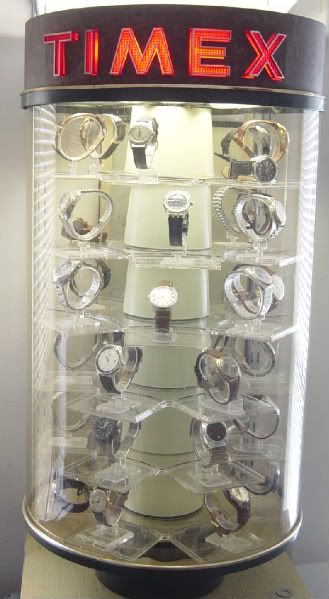
My latest silly purchase: A 1970 Timex display cabinet. This year is pretty well centered in the era of watches I like best. Most watches were still fully mechanical. Go back 10 years, and watches were tiny by todays' standards. Forward 10 years, and they are mostly quartz--Superior timekeepers, but it isn't nearly as interesting when even a basic department store watch is equal (or superior) in performance to an expensive luxury brand.

Monday, May 12, 2008

Brief history of watches

Hell in a Handbasket linked to a recent post, saying that "although his passion are American made watches which use mechanical movement." Close, but not quite--There's really no such thing as an affordable American-made watch in the era I like best. 
A brief history of American-market Watches: 
 Until about 1850, England and Switzerland dominated watchmaking. English watches were more practical, Swiss fancier. Waltham in Massachusetts was the first to assembly-line watches, drastically reducing the price of a decent watch--instead of a single skilled watchmaker taking weeks or months to make a watch, a factory would produce higher-quality watches with 3-4 days labor. The downside was that there were few options on factory watches--In order to get these economies, they had to make thousands near-identical. Elgin in Illinois followed a few years later, and together they dominated the vast middle ground of watches for decades. Swiss watches were inferior, and there was a significant problem with "Swiss Fakes"--Swiss watches disguised as American, with either sound-alike brands or actual counterfeits. 
 The predecessor to Timex started as the Waterbury clock company, who later absorbed Ingersoll, and operated for a while as US Time. They specialized in very inexpensive watches--"The watch that made the dollar famous" was one slogan. A far cry from the jeweled watches of Waltham and Elgin, they were affordable and sturdy, but not long-lasting. 
 It is unclear who made the first real wristwatch. There were ladies versions by Patek-Phillipe in the late 1800s. Cartier claims the first men's wristwatch in 1902, and they became more and more popular during and after WWI, as their practicality became evident. The Swiss were more willing to change, and wristwatches helped them regain prominence. During WWII, the US companies could not produce watches for civilians, and after took some time to re-tool from wartime manufacturing back to watches. This also helped the Swiss. American companies kept with their original tradition--Simple but well-made watches, with few features. The Swiss added calenders and automatic winding. American companies relied more and more on Swiss parts, and by the early 60's, most of the American brands had new, foreign owners. (Currently, MZ Berger owns the Waltham, Elgin and Gruen in the US. Hamilton is owned by Swatch. Bulova has recently been bought by Citizen. A Swiss descendant of the original Waltham remains, selling primarily in Japan) 
 In the 1957, Hamilton in the US sold the first electric watch, soon followed by several other companies. This used a small (for the time) battery that powered the watch for about a year. These watches had teething problems--They were purely electric, retaining the balance wheel and most of the gears of a traditional watch, but substituting electrical contacts and electromagnets for the mainspring. The contacts would arc slightly, several times per second eventually damaging them. These watches had very little to recommend them over the proven automatic wind watches. 
In 1960, Bulova came out with the Accutron, arguably the biggest leap in watchmaking since the mid 1800's. An electronically-controlled tuning fork drove the watch, allowing a mid-priced watch to have accuracy not possible in a wristwatch up to that point. Instead of the tic-tock of a standard watch, Accutrons have a low-pitched hum, and the second hand gliding smoothly with no starting or stopping.
Japanese watches were nearly unheard of in the US until the late 60's, when they were brought home by returning Viet Nam veterans. In December 1969, Seiko sold the first quartz watch, followed within months by a consortium of Swiss companies. These had traditional hands. The Seiko was very close to a modern design, using a stepper motor and a second hand that jumped in 1 second intervals. The Swiss used a variation of the Accutron tuning fork with its gliding hand. 1972 brought us Hamilton's Pulsar brand, the first digital. This watch was an LED design, requiring the user to push a button to read, initially costing $1200. Shortly after, Gruen launched the Teletime, the first modern LCD at around $200. In 1975, Texas Instruments began selling an LED watch for $20, and this price dropped to $10 a year later. Hamilton wound up bankrupt, and the Pulsar name was sold several times, eventually bought by Seiko, and used as a lower-cost analog brand. By the 80's, most watches sold in the US were quartz. Swiss watches suffered greatly, and most of the "everyday" brands were discontinued. A modern $10 quartz watch is more accurate than a $10,000 Swiss watch.